dWeb.News: 63% of workers who file an EEOC discrimination complaint lose their jobs

63% of workers who file an EEOC discrimination complaint lose their jobs

Author: Daniel Webster
People who experience sex discrimination, race discrimination and other forms of discrimination at work aren't getting much protection from the laws designed to shield them from it.

That's our main finding after analyzing the outcomes of 683,419 discrimination cases filed with the U.S. Equal Employment Opportunity Commission from 2012 to 2016 – the most recent data available. We focused on workplace complaints filed related to race, sex, disability, age and national origin. Those are the five most common categories.

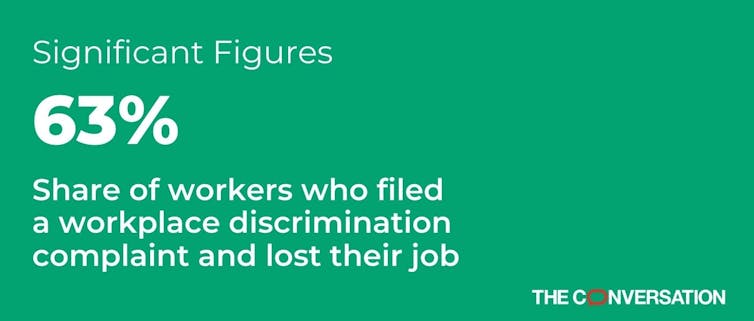
We found that at least 63% of workers who filed a complaint eventually lost their job. That number was even higher for workers who filed a disability-related claim, at 67%. And about 40% of workers reporting experiencing employer retaliation, such as verbal abuse or being passed over for work opportunities like training or promotion, for filing a claim. At 46%, employer retaliation was most common for sex discrimination cases.

Moreover, the complaints themselves rarely led to a successful outcome for the workers who filed them. Our analysis found that legal redress in the form of negotiated or mandated changes in workplace practices occurred in only 7% of all cases. Workers received monetary awards in 12% of the cases – with a median payout of only US$8,500.

These patterns may explain why only a fraction of people who believe that they have experienced discrimination at work actually file a complaint. Legal standards to prove discrimination to the EEOC or in court are quite high, and the burden of proof falls largely on the employee.

Low rates of discrimination claim filing may also suggest that people see the legal route as dangerous with low chances of success. Enduring discrimination on the job and proving it in court or to the government are quite different things.

Lawmakers have been debating measures to beef up protections for workers for years, such as the Paycheck Fairness Act, a bill aimed at wage discrimination, or paying workers doing the same job differently based on their sex, race or national origin. Besides increasing pay transparency, the bill would shift more of the burden of proof to the employer.

While we believe passage of this legislation would be a good step to encourage more workers to report discrimination, our research shows that increased protections should be applied to all types of discrimination. But giving workers the protection from discrimination that we feel they deserve likely will require stronger enforcement efforts and stiffer penalties for employers who break the law.

The Conversation

Donald T. Tomaskovic-Devey receives funding from the W.K.Kellog Foundation.
Carly McCann is affiliated with the Center for Employment Equity at UMass-Amherst.
JD Swerzenski is affiliated with the Center for Employment Equity at UMass-Amherst.

More Legal Professional Services Business News dWeb.News
facebook twitter 

Comments

Popular posts from this blog

dWeb.News: Children’s Book Publisher Lil’ Libros Has Raised Over $2 MILLION in Equity Crowdfunding by Inviting Community to Become Investors and Build a Legacy of Generational Wealth Through Bilingual Literacy

Children's Book Publisher Lil' Libros Has Raised Over $2 MILLION in Equity Crowdfunding by Inviting Community to Become Investors and Build a Legacy of Generational Wealth Through Bilingual Literacy Author: Daniel Webster ...

dWeb.News: Video: How to awkwardly interact with people at a bar using chemistry

Video: How to awkwardly interact with people at a bar using chemistry Author: Daniel Webster share this! ...

dWebServe Submit News Opinions Worldwide

dWebServe Submit News Opinions Worldwide Reinforcement learning competition pushes the boundaries of embodied AI Archeologists Found 110 Ancient Egyptian Tombs Spanning 3 Historic Eras This Modder Stuck a Wii Into a GameBoy Advance SP Samsung’s SmartTag+ Bluetooth Tracker Arrives in the U.S. dWeb News Daily Picks by Daniel Webster Internet Cowboy How Intel is leveraging AI to drive sales Data science in a post-COVID world Zillow Group responds to lawsuit filed by Real Estate Exchange, denies antitrust claims How to Set up Do Not Disturb on Google Pixel Phones How commercial space stations could become the final frontier for data and cybersecurity Reinforcement learning competition pushes the boundaries of embodied AI Posted: 01 May 2021 02:40 PM PDT The ThreeDWorld Transport Challenge lets embodied AI scientists test a robot’s ability to physically sense and interact wi...